

You open a message and see “CC me.” Or a friend writes “CC’ing you” in a chat. What does that mean? The CC meaning in text is simple. CC stands for carbon copy. It means you send a copy of a message to another person so they stay informed.
This short term began in email. Now people use it in texts, group chats, and social media too. Sometimes it even means something else, like closed captions. In this guide, you will learn what CC means, where it came from, and how to use it. You will also see plenty of easy examples.
What Does CC Mean in Text Messages?
CC means carbon copy. In a text or chat, it means you want someone to get a copy of the message. The person is not the main receiver. They just need to know what was said. In email, CC is a real field. In texts and social media, people type it by hand. It is a quick way to say, “Keep this person in the loop.”
CC Meaning in Simple Words
Think of CC as a “just so you know” tag. You are talking to one person. But you want a second person to see the message too.
Here is a simple way to picture it. Your friend Sam asks you about the party time. You answer Sam. Then you CC your sister because she is coming too. Sam is the main person. Your sister is the extra person who stays informed.
The CC meaning in text works the same way in every app. One person gets the message. Another person gets a copy.
Part of Speech and Grammar
CC is an abbreviation. It can act as a noun or a verb.
As a noun, it names the copy or the email field. For example: “Add her to the CC line.” You can also say: “I sent you a CC.”
As a verb, it means to send a copy. For example: “Please CC me on that email.” Here are the common forms:
- CC (base form): “I will CC the team.”
- CC’d (past tense): “She CC’d her manager.”
- CCing or CC’ing (ongoing action): “I am CCing you now.”
People write it in capital letters. You may also see “cc” in lowercase in quick chats. Both are fine in casual messages. For work emails, capital letters look neater.
Where Did CC Come From?
The CC abbreviation meaning goes back to the age of typewriters. Offices used thin sheets called carbon paper. You placed a sheet of carbon paper between two pieces of plain paper. When you typed on the top page, the carbon paper pressed ink onto the page below. That gave you a duplicate document.
The second page was called a carbon copy. Offices often gave these copies to people who needed to know what was written but were not the main reader. That is how the idea of “copying someone” started in business correspondence.
Later, email borrowed the same idea. Email programs added a CC field, and the old name stuck. Today nobody uses carbon paper to send an email. Yet the term lives on.
Read Related Post: What Is WTV? Meaning in Text, Slang, Examples, and How to Use It
CC Meaning in Email
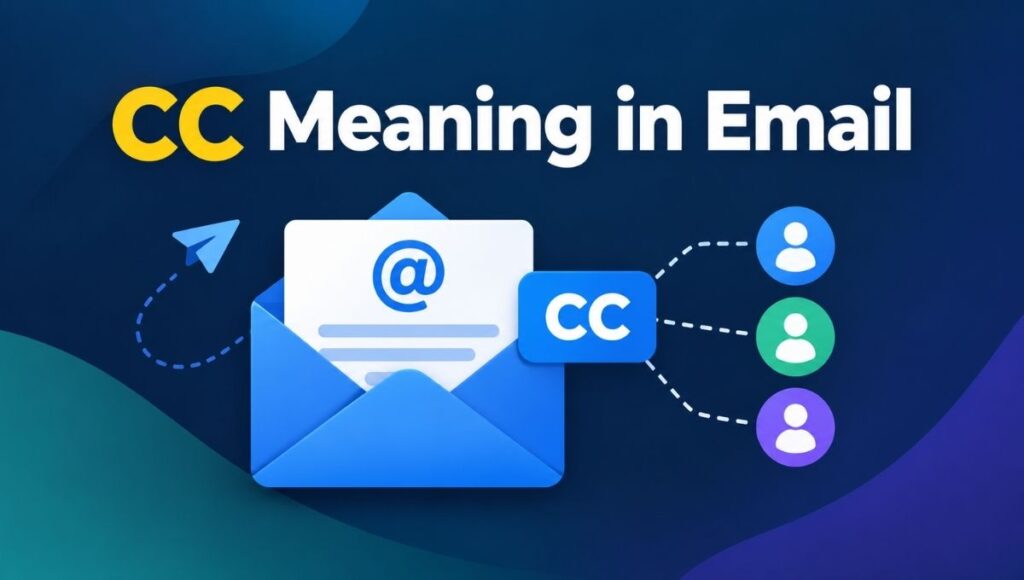
Email is where CC is used the most. Every email has a few fields. The “To” field holds the main recipient. The CC field holds an additional recipient. That person gets a copy of the original message.
Here is what happens when you CC someone:
- The person receives the email in their inbox.
- Everyone on the email can see their name.
- They can read the whole email thread.
- They do not have to reply.
In Gmail, you click the “Cc” link at the right side of the “To” box. A new field opens. Then you type the email address of the person you want to copy. Other email programs work in a similar way.
CC is one of the most common email communication terms. In professional emails, it helps teams share updates without extra meetings.
CC Meaning in Texting and Chat
A regular text message has no CC field. So people write “CC” by hand. The CC meaning in text here is a quick note that says, “I am sharing this with someone else.”
You may see it in a few ways. A person may write “CC me” when they want to see a message too. Another person may write “CC’ing Maya” before pasting a message into a group chat.
In casual conversations, CC can also mean a friend should look at something. For example: “Check this out. CC Jordan.” It is like saying, “Jordan, this is for you too.”
CC is less formal in chat than in email. It works well with friends and coworkers you know. For a very serious message, it is better to write a full sentence.
CC Meaning on Social Media
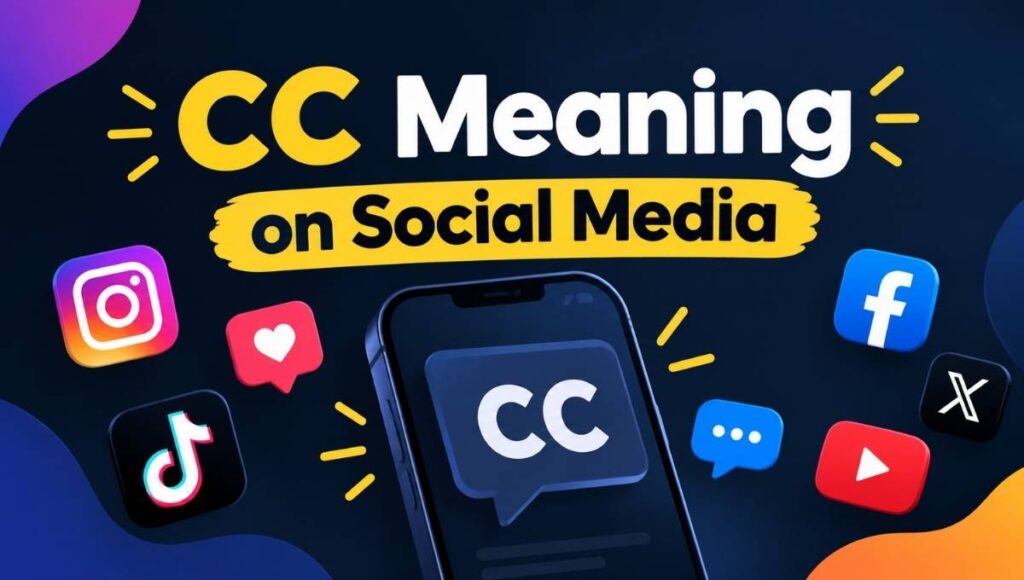
On social media platforms, CC does not always mean carbon copy. The meaning depends on where you see it.
Instagram: People often write “CC” in comments and add a friend’s name. It is a light way of social media tagging. It tells the friend to look at the post. The CC meaning in text on Instagram is much like a tag.
TikTok: In comments, CC can mean the same thing. A user may write “CC my friend” to point out a video. But CC can also mean closed captions or “content creator.” Check the video or the comment for clues.
WhatsApp: WhatsApp has no real CC field. If someone writes “CC” in a chat, they mean “I am adding you to this talk.” In a group chat, a person might type “CC Ali” so Ali notices the message.
On YouTube and other video apps, the CC button turns on closed captions. That is a different meaning, but it is common online.
Examples in Sentences
Examples make the term easier to learn. Here are some real-life lines.
In email:
- “Please CC me on the update.”
- “I will CC the client so they see the plan.”
- “I am copying you on this email for your records.”
In text and chat:
- “CC me on the group message, please.”
- “CC’ing you so you know the plan.”
- “Keep me CC’d on the project talk.”
On social media:
- “This recipe is so good. CC my sister.”
- “CC your friend who loves dogs.”
In the workplace:
- “I will CC the manager for visibility.”
- “Add me to the email thread so I stay informed.”
Each line has the same idea. One person is the main reader. Another person gets a copy.
Synonyms and Antonyms
CC does not have perfect twins, but some phrases come close. Here is a quick table.
| Type | Word or Phrase | How It Compares |
| Synonym | Copy someone | Very close in meaning |
| Synonym | Keep someone in the loop | Casual, friendly |
| Synonym | Include someone | Simple and general |
| Synonym | Share a copy | Plain and clear |
| Synonym | Loop someone in | Common at work |
| Antonym | BCC | Copy sent in secret |
| Antonym | Leave someone out | Do not include them |
| Antonym | Exclude | Formal word for leaving out |
BCC is not a perfect opposite. It still sends a copy. But it hides the name of the person, so it is a very different action.
CC vs BCC, Reply All, Forward, and Tag
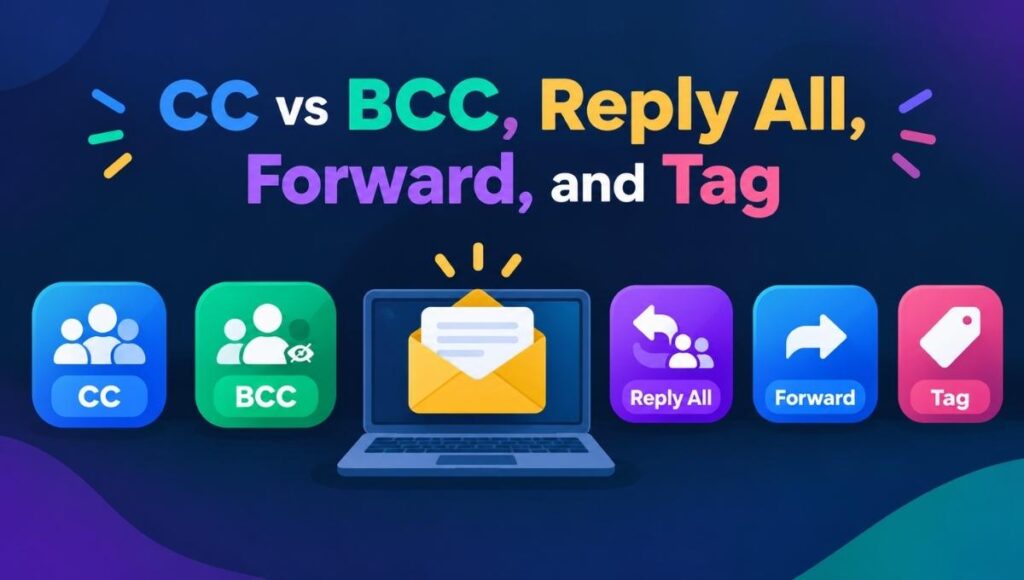
CC has a few close cousins. People mix them up often. Let us clear it up.
CC vs BCC. BCC means blind carbon copy. The person gets the email, but nobody else can see their name. With CC, everyone sees who was copied. BCC protects recipient privacy. It is useful for big lists.
CC vs Reply All. CC is a field you fill in. Reply All is a button you press. It sends your answer to everyone on the email, including people in CC.
CC vs Forward. CC happens when you first send the email. Email forwarding happens later. You send an old message to someone who was not on it.
CC vs Tag. A tag, or mention, calls a person’s name inside an app, such as @name. It sends them an alert. CC is softer. It says, “I am sharing this with you.”
CC vs primary recipient. The primary recipient is the one who should act or reply. The CC person only needs to read.
Related Phrases and Common Expressions
People use CC in many short phrases. Here are common ones:
- “CC me” or “Please CC me”
- “CC me on the email”
- “CC’ing you” or “Copying you on this email”
- “CC the team,” “CC the manager,” or “CC the client”
- “CC everyone” or “CC the group”
- “CC for visibility” (so others can see the message)
- “CC for the record” (so there is proof it was sent)
- “Keep me in the loop” or “Include me in future updates”
The phrase “CC for the record” is popular at work. It means the email is kept as proof. The phrase “CC for visibility” simply means more people can see the news.
You may also hear “Add me to the email thread.” That is the same as asking to be CC’d.
Why People CC Others and When to Do It
There are a few good reasons to CC someone.
To keep people informed. A team member may not need to act, but they should know what is going on.
To build trust. When many people see a message, it adds communication transparency. Nobody feels left out.
To show accountability. If a manager is CC’d, the sender knows the work is being watched. This is why some people CC their boss.
To save time. One email can reach everyone at once.
Use CC when someone needs to see the message but does not need to answer. Good email etiquette also means using CC only for the right people. If a person must reply, put them in the “To” field instead.
Common Mistakes to Avoid
Even a simple tool can cause trouble. Watch out for these mistakes.
Copying too many people. A long CC list clogs inboxes. Add only people who need the news.
Using CC to show off. Copying a boss to put pressure on a coworker can feel rude. It may hurt trust.
Mixing up CC and BCC. If you use CC for a private list, everyone sees each other’s email address. Use BCC when privacy matters.
Replying All by accident. When you press Reply All, every CC’d person gets your answer. Sometimes that is not what you want.
Assuming CC works in every app. In most texts, CC is only a typed word. It will not send a copy by itself. The CC meaning in text is a message to the reader, not a button.
Writing CC in a very formal note. In a serious letter or job email, a full sentence is clearer.
FAQ
What does CC mean in text messages?
CC means carbon copy. In a text, it tells the reader that someone else should see the message too. It is a short way to say, “I am sharing this with another person.”
Does CC mean tag someone?
Not exactly. In email, CC copies a person on a message. On social media, people may write CC with a name to point a friend to a post. That works like a tag, but it is less formal.
Do I need to reply when I am CC’d?
No. Being CC’d usually means “for your information.” You can read the message and stay quiet. You only reply if you have something useful to add.
Can everyone see who is CC’d on an email?
Yes. All names in the CC field are visible to every recipient. If you want to hide names, use BCC instead.
Is CC formal or informal?
It can be both. In workplace communication, CC is a normal and polite email tool. In texting, it is a casual shortcut among friends.
How do I respond when someone says “CC me”?
Add their name or email to the CC field if you are sending an email. In a chat, paste or share the message with them. A simple “Done” or “Sent” is a nice reply.
Conclusion
CC is a small term with a long history. It began with typewriters and carbon paper. Now it helps people share messages quickly in email, texts, and chats. The CC meaning in text is easy to remember. It means “I am sending a copy so you stay informed.”
Use CC with care. Copy only the people who need to see the message. Pick BCC when privacy matters. And when you see CC on a video app, check if it means closed captions. With these tips, you can use CC with confidence in every message you send.
